Security Gap Visualization
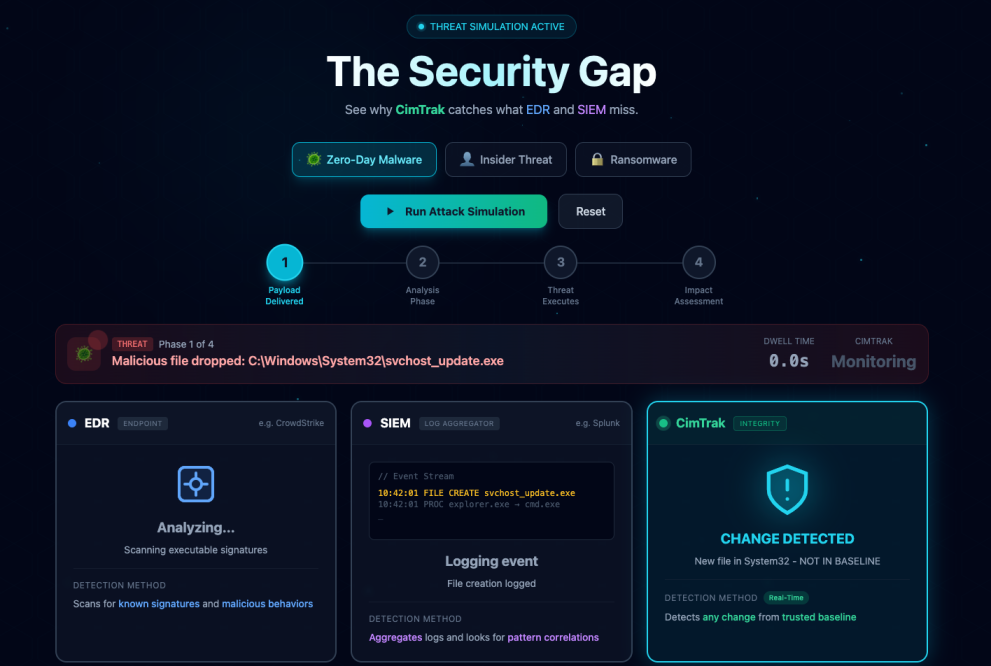
See how CimTrak helps organizations strengthen security with real-time monitoring, change detection, and continuous visibility across critical systems. Take the threat simulation to evaluate your security readiness and discover opportunities to improve threat detection and response.
Start the threat simulation today. Contact GHA Technologies, Inc. to learn how CimTrak can help you build a stronger, more resilient security strategy.
What is security gap visualization?
Security gap visualization is a way of visually mapping where your security controls fall short against the risks and assets you need to protect. Instead of only listing alerts, logs, or compliance checks, it focuses on showing:
- Which areas are covered by existing security tools and processes
- Where gaps exist—for example, unmonitored systems, missing controls, or weak configurations
- How severe each gap is in the context of your environment
Traditional dashboards often present raw metrics (number of alerts, patch status, tool uptime). Security gap visualization reimagines this by connecting those data points into a clear picture of risk coverage vs. exposure, so teams can see at a glance where they are protected and where they are not.
Why does visualizing security gaps matter?
Visualizing security gaps helps teams move from reacting to alerts to proactively managing risk. When gaps are clearly mapped, you can:
- Prioritize remediation by focusing on the most exposed assets or highest-impact gaps first
- Align security investments with actual coverage needs instead of buying overlapping tools
- Communicate with leadership using visuals that make risk and progress easier to understand
For example, instead of saying “we have open vulnerabilities,” you can show that specific business-critical systems lack endpoint protection or network monitoring. That kind of visualization supports better decisions on budget, staffing, and timelines.
Who benefits from security gap visualization?
Security gap visualization is useful for several groups across the organization:
- Security and IT teams use it to see where controls are missing or misconfigured, plan remediation work, and track progress over time.
- Risk and compliance teams use it to connect technical gaps to policy or regulatory requirements, making it easier to show how controls map to frameworks.
- Executives and business leaders use high-level views to understand where the organization is exposed and how security initiatives are reducing that exposure.
In practice, this means moving from scattered reports to a shared visual view of coverage and gaps, helping everyone make more informed, coordinated decisions about security priorities.
Security Gap Visualization
published by GHA Technologies, Inc.
GHA Technologies, Inc. is a nationally expanding network, computer reseller and systems integrator with offices nationwide. We sell HP, Dell, IBM, Lenovo, Nimble, EMC, NetApp, Sony, Apple, VMware, Samsung, Fujitsu, APC, Symantec, Panasonic, Microsoft, Intel, Cisco, and all the latest storage, datacenter, virtualization, cloud, security, VoIP, wireless, video and identification technologies. We also specialize in mission-critical product procurement and integration services for some of the largest corporate, government, and educational clients in the US. Our client base is a Who's Who of Corporate America.
Currently, GHA has over 175 employees with annual sales of approximately $290 million and growing at a rate of 15%. GHA continues to hire 7 to 12 new sales professionals every five weeks nationwide. GHA has highly motivated and talented salespeople who provide the highest level of service to their customers. Call or email us to find out more!
Key Benefits
- One of the largest privately held computer companies in America
- Real, Personalize Customer Service
- One Stop Shopping Convenience




 Sign in with LinkedIn